PAGE 2
| A
Trip To Rome in 1959 and other memories by David Walker The Trip To Rome (as recorded at the time in The Pelican) by P Maggiore, I Netton and D Walker Galley Down by Andrew Coyle The Happiest Days by Fr John Maguire |
|
The
Trip To Rome
By Paul Maggiore, Ian Netton and David Walker
Taken from The Pelican, Summer 1961
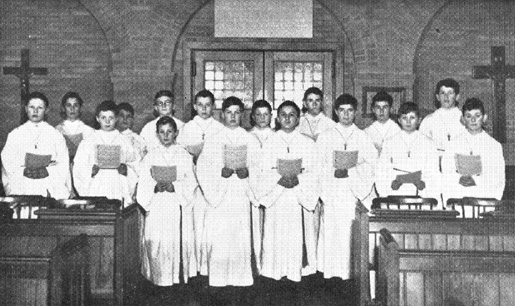
Our Group, officially called the "Little Singers of the Celtic Cross", was chosen to represent Great Britain at the International Congress of the "Pueri Cantores". Seventeen of us then, together with Father Conway, our Choir-master and Father McKenna our Infirmarian, assembled in London on St Stephen's Day—Boxing Day. All four nationalities of the home countries were represented—we even had a Welshman, J. Mattock! We spent most of the day resting from the first part of our journey at the Scholasticate at Totteridge, London, where we had supper altogether, sang Benediction for the Scholastics and gave them a small concert which included our signature tune, "Gaudeamus Igitur". Fr Provincial and another Father drove us all to Victoria Station where we were to catch the Night Ferry for France.
|
After Mass we visited the famous treasury of the Basilica. As we did not have
much time we had a quick look round before making our way to the other end of
Paris to the White Fathers' House where lunch had been prepared for us. But
who cared about eating when there was cider and wine on the table! |
How they managed it we don't know, but Father Conway and Father
McKenna found themselves in the middle of this (some even say that they carried
the banner) and it is rumoured that nobody even noticed! |
Galley Down! To all Priorians these two words are words of magic. They stand for
freedom from Latin, French and Maths., freedom from authority, and freedom from
the strain of everyday life at the Priory. Outsiders are unable to understand
the pleasure we get from Galley Down, and are apt to regard us as people to be
pitied, or perhaps even feared, when they see us dragging great bundles of wood
through clearings, or plunging through the undergrowth. Only those, who have themselves
been Priorians can really understand just what Galley Down means to us. Generations
of White Father students have camped at Galley Down, and the procedure has always
been the same. For the benefit of the uninitiated, this procedure is as follows. The boys, who intend going camping, split up into small groups; five or six is the best number for a group, but usually there are more. The group arrives at Galley Down at about half past ten, having walked the two miles from the college, via the village, thereby giving the villagers something to stare at. We certainly must look a queer crew, with saucepan handles protruding from the knapsacks on our backs. As soon as we arrive, the work starts. One person goes for water from our hygienic reservoir; others collect wood; while the less fortunate peel the potatoes. After enough wood has been collected, a fire is started. I think that I can honestly say that I have still to see the person, even if he has been a Scout, light a fire with only one match! Once the fire is started, usually half an hour and a box of matches later, the cooking begins. One person, not always the most gifted, is appointed cook. If there is a gourmet in the group who, being a cut above the common horde, desires a special dish, he is quite welcome to have it—if he cooks it himself ! |
However, there are not usually many gourmets in the group but almost everyone
is a gourmand ! For about half an hour, silence reigns, as vast heaps of potatoes,
beans, sausages and eggs disappear. After dinner the sensible people have a nice
quiet snooze and allow their dinner to settle. The size of a person's dinner is
always in proportion to his siesta. As Confucius says, He who eats most, sleeps
longest.Some people sleep all afternoon, but most wander off after a while. Some play
football in the deep carpet of dead leaves; others go off to explore in the undergrowth;
while others again just wander round, for, in Spring especially, there is no place
more beautiful than Galley Down. |
THE HAPPIEST DAYS. .
.
By Father John Maguire
Taken from The Pelican, Summer 1962 (Jubilee Number)
The Priory was entering upon the second period of its existence when I arrived there in September, 1927. Father Travers, the Founder of the house and its first Superior, had died a few months earlier and his successor, Father Bouniol, had just taken over when I appeared to join three members of my home parish who were already Priorians—Fathers Ryan, Burridge and Beckwith. Father Bouniol had been at the Priory since its foundation, and by 1927 he was already something of a tradition, not only in the house, but throughout the diocese. We all stood a little in awe of him, for despite his kindly heart and ready sympathy he was a strict disciplinarian, capable of reducing a boy to complete submission with a few well-chosen, though often mispronounced sentences. He was a man of deep humility, and when one of his outbursts had pulverised a lad would often take him aside and apologise for being so hard on him. The few private words would soon dispel any feeling of resentment, and the boys would all have cheerfully undertaken any task for him. When therefore he decreed that a football pitch was to be cut out of the sloping field adjoining the house everyone turned out in force and maintained their efforts over a period of long and weary months; our flagging energies would be restored and our enthusiasm renewed by his words of encouragement and by his own generous example with spade and pickaxe. Father Howell, the first Old Priorian to join the staff, had been teaching at the Priory for a year when I arrived, and he was joined in the same month by Father Hughes, fresh from ordination at Carthage. They were the first-fruits of the Priory's early years, and they were both destined to accomplish much both for the White Fathers in England and for the Church in Africa. Father Howell I never had in class, and it is his prowess on the football field that I recall most vividly. The fact that rumour credited him with having played for Woolwich during his army career made him an idol in our eyes and House teams vied with each other in an effort to obtain his services for a match. Father Hughes was not the athletic type and appeared but rarely on the sports field. It was academically that he excelled, though I must admit that at this distance I can recall only the general impression of an interesting teacher: the actual matter he taught has become blurred. For all his small stature and gentle ways Father Hughes knew how to impose his authority on his unruly charges and it was not long before he had an attentive and disciplined class. One youngster destined to become a "dashing Colonel" in the Second World War, tried to put him to the test but was quickly reduced to silence, and indeed to tears, by the quiet but determined little priest. Neither of the two English priests remained long at the Priory, for with the foundation of Heston in 1928 their services were required in the parish and on promotion work. The remainder of the staff was mostly made up of young French-Canadian Fathers. There was one exception, Father Roy, who was a Franco-American who used to amuse us by repeating at intervals, in strong nasal tones, "I am the only member of my family who does not speak through his nose." Father Bolduc was somewhat older than the others for he had served in a parish in Canada before joining the White Fathers. He struck us as a very solid sort, very intense about anything he took up. He carried this earnestness even on to the football field, and used to shout as he stood in the goalmouth "Pass the ball, my boy, pass the ball, I say!" He returned to Canada after a few years with us and became something of a legend as a propagandist being credited with strange powers which could move the hardest of hearts to give generously in favour of the Missions. Two future Assistants of successive Superiors General were at the Priory in those days: Father Côté, who joined the staff at the same time as Father Howell, and Father R. Walsh, still a student in Syntax. Father Walsh was a great sportsman until an attack of rheumatic fever laid him low, and he had the distinction of being elected Captain of the School while still in Poetry, as the Fourth was called in those days. Father Côté was Father Bouniol's successor as Bursar of the House, and the many journeys which his work entailed were made on a motor-bicycle combination which became a familiar sight in the neighbourhood. I well remember the day he pulled up outside the Superior's office at daybreak and produced a youngster from the sidecar whom he ushered into the Superior's room. |
This youth had decided
that his stars were calling him elsewhere and instead of arranging matters with
the authorities had set off on his own only to be caught near Andover and brought
back in disgrace by the Bursar. He stayed on for a while but eventually left
in a more regular way. I last heard of him as a stalwart member of a praesidium
of the Legion of Mary in the Middle East, where he settled after the war. While
engaged in teaching on the Seminary staff Father Côté was allowed
to follow a Teachers' Training Course at Southampton University. Whenever one
of his inspectors was due, we would be coached in a particular subject, and
it was made clear to us that we were to co-operate fully with our teacher. We
were forbidden to open our mouths while a French inspection was taking place,
which we considered a slur on our ability in that language!
As the "Roaring Twenties" were drawing to a close, we welcomed to
the Priory two new members of the future British Province, Fathers Marchant
and Keane, ordained in North Africa in June, 1929. Father Keane immediately
took over our instruction in Latin and Mathematics, and soon came to the conclusion
that we were in need of a reforming hand, which he supplied. Father Marchant
had an immense store of energy and enthusiasm, and we realised that it was all
used for our benefit. From him I learned, the hard way, that prevarication does
not pay, and that it is better to tell the truth and nothing but the truth.
Thursdays were entirely devoted to the study of English, and in this subject
we had the advantage of the expert knowledge of a neighbouring parish priest,
Father (now Canon) J. P. Murphy. We always felt very important in his classes,
for he insisted on addressing us collectively as "Gentlemen" and individually
as "Mr. So-and-So". He knew how to encourage ability and to draw out
latent powers, and to him we owed our appreciation of the English language.
He could deflate anyone whose knowledge of English did not equal the opinion
he held of it. On one occasion he went painstakingly through a collection of
our essays, all obviously based upon a common source, until he came to the one
exception. "Ha, Mr. X, you have not used the common source, I see."
There was an ominous silence as he turned over the pages of the essay, and then,
with a dry chuckle, he continued: "Rather a pity, I think, that you did
not keep to the well trodden ways." It was the tone of voice rather than
the words themselves which left the unfortunate essayist in no doubt about the
worth of his production.
|